Showing posts with label Independent Component. Show all posts

Thursday, April 25, 2013

Independent Component 2:Update

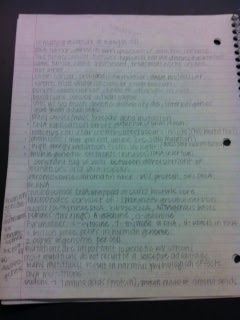
Here are the notes for lecture 2 of Biology of Cancer class! in this lecture, angiogenesis was discussed. angiogenesis is the growth of blood vessels to the tumor, which causes the tumor to receive nutrients, oxygen,etc. and thus causes the tumor to grow/spread. I also learned about the vascular endothelail growth factor (VEGF), which is the most potent proangiogenic pathway to get nutrients and other materials to tumor cells.


Blog 21: Independent Component 2

LITERAL
(a) Statement saying: “I, Cynthia Garcia, affirm that I completed my independent component which represents 30 hours of work.”
(b) The sources that helped me complete the independent component were the Head and Neck Surgery Dept. at Kaiser Permanente BP, and the Biology of Cancer class taken at Cal Poly Pomona. 
(c) Independent Component 2 Log * see Sheet 2

Dr. Alas email:alas@csupomona.edu
Odette Van Der Eb: (626) 851-6063
(d) The 30 hours were completed by going to the hospital to do extra mentorship. There, I had to restock the exam rooms with the materials needed, such as gauzes, OR towels, CHUX, needles, etc. I am more familiarized with the materials used, so when aiding the medical assistants in Mohs, I can give them the exact material that they need. I have also completed the 30 hours by attending my college class, Biology of Cancer every Monday and Tuesday with Dr. Alas from 4-6pm. There I get to learn about the different processes a tumor takes to infect the body with this disease.  Explanation of what you completed.    

INTERPRETIVE 
Defend your work and explain how the significant parts of your component and how it demonstrates 30 hours of work.   Provide evidence (photos, transcript, art work, videos, etc) of the 30 hours of work.  

The work that I did for my Independent Component represents 30 hours of work because although I did not get the opportunity to attend Mohs Night as often as I would have liked, I was able to complete the 30+ hours by volunteering more at the Head and Neck Department. My experiences there have truly been worthwhile because it is fun interacting with the staff, since you learn so much from them. Considering the fact that I have been going regularly to the hospital, the medical assistants have gained more trust in me. When I was able to stay for Mohs Night, the medical assistants that I was observing had me put materials in the room or put surgical instruments in the "cleaning room." I also had the opportunity to converse with Jennifer Lee an M.D at the HNS department, who guided me into a more specific topic for my senior project.  The Biology of Cancer class that I am currently taking is an extremely important part of my Independent Component because it aids in my understanding of how a tumor develops and the process that it takes to metastasis. Learning biology, even more so the biology of cancer, can be difficult to the memorization that is needed for tests and reports, so it is vital for me to take through notes. As you can see from the blog posts below, these are alot of notes, but I learn something new everyday. This two hour, upper division course at Cal Poly has really tested my ability to memorize, but also retain information, as i just had my midterm this past Wednesday, so we will see how that goes. 

Independent Component 2 Update

Lecture Notes
Lecture 2 Notes
Mentorship Update


APPLIED
How did the component help you answer your EQ or support one or more of your answers.  Please include specific examples to illustrate how it helped. 

This component,specifically my college class, helped with with my overall senior project because it  helped me understand the biological process of cancer. Before taking this course, for my senior project I was only focusing on the type of tumor, stage, and possible treatment for the patient. With the new information that I have acquired through this class, I have learned that there is so much more to cancer than the type and treatments for it. For example, in lecture 2,  I learned about angiogenesis, the formation of blood vessels to the tumor cells in order to have nutrients and oxygen supplied to the infected area. Since the tumors form vasculature that connects them with the circulatory system, the tumor is transported to other parts of the body, known as metastasis. Metastasis plays an important factor in the treatment for the patient because metastasize is included in the staging of cancer. The staging of cancer plays a determining factor for the treatment the patient receives. The guest lectures have also aided me when closely examining the answers to my essential question, especially Dr. Trisal. Since I am now focusing my senior project on skin cancer, when he was lecturing, he enlightened about what I need to focus on regarding skin cancer, and the best treatment: prevention! This is my third answer to my essential question, but from analyzing the information that I have received from the guest lecturers, this answer is possibly my best answer. Surgery and follow-up care can only do so much for the patient, but prevention will lead people to have a lower risk of developing skin cancer, especially the most dangerous one, melanoma. 

Wednesday, April 17, 2013

Independent Component 2: Update

Today,a very special guest came by to discuss skin cancer. Dr. Vijay Trisal, from City of Hope, is a general surgeon, but received his fellowship in surgical oncology. Here is a link of his biographical information.  In today's lecture, Dr. Trisal discussed about the types of skin cancers, from the the most common (basal, squamous cell carcinoma, melanoma) to the most rare (merkecl cell carcinoma). He also discussed the staging of skin cancer, treatment options, and preventative measures one should take to avoid skin cancer.
Please excuse the pictures, they are not of the best quality.
Here is Dr. Trisal!


Monday, April 15, 2013

Independent Component 2: Update


Here are the notes from the first lecture of my Bio of Cancer class! We are currently in Week 3 of the class. These are all ALOT of notes, but they prove to be very informative. This first lecture was about the history of cancer, benign and malignant tumors, and the creation of tumor cells in the body.

Friday, April 12, 2013

Independent Component 2: Update

The Biology of Cancer class has finally begun! Before actually taking the class however, I had to get  permission from the professor and also from the Biology department due to the fact that it is an upper-division course offered at Cal Poly. Due to my standing, I had to do the over-ride process so I could actually enroll in the class. Here is my young scholar permission form, which officially allows me to take the course.

Saturday, February 2, 2013

Blog 15: Independent Component 2 Approval


CONTENT:
(1) Write a description of what you plan on doing for your independent study component.
For my second Independent Component, I plan on continuing to go to Mohs Night, at the Head and Neck Surgery department at Kaiser Permanente Baldwin Park. Before, in my first independent component, I studied how the doctors practiced the Mohs technique and what were the procedures that the nurses followed during the procedure. Now, I want to examine how the doctors interact with the patients because that is an important step in the and well being of the patient during and after the procedure. I am also going to volunteer more and have the opportunity to take a college class at Cal Poly Pomona. The class that I am going to be taking is Biology of Cancer on Mondays and Wednesdays from 4:00-6:00pm (starting 4/2/2013).
(2) Describe in detail how you think your plan will meet the 30 hours work requirement.
My plan will meet the 30 hours work requirement because I will go every Monday or Thursday for 3 or 4 hours for several weeks to observe the doctors and medical assistants. On some occasions, they conduct Mohs on Wednesdays, so there is a possibility that I might attend that day so I can complete the 30 hours requirement. I am also going to go more often to volunteer and attend classes regularly.
(3) How does your independent study component relate to your working EQ?
My independent  component relates to my essential question, which is, What is the best way to treat head and neck cancer in adults, because from this experience I did not only get knowledge about the Mohs procedure, but I will also see how each of the different doctors interact with each patient and the methods they use to ensure that both the surgery and the patient are well. This relates to my EQ because treating a patient does not only involve the best treatment for them, but also the follow-up care they receive and what the outcome is for the patient. The Bio of Cancer class will also aid my understanding  about how patients acquire cancer and the effects that the tumor cells have on the body.

Thursday, January 31, 2013

Blog 14: Independent Comp. 1


Content:

LITERAL
(a) Statement saying: “I,Cynthia Garcia, affirm that I completed my independent component which represents 30 hours of work.”
(b) Odette Van Der Ed
(626) 851-6063
 *specify MOHS Night
(c) Independent Component 1 Log
(d) During MOHS night, I would observe the doctors and the medical assistants perform the Mohs techinque for skin cancer. For the Mohs technique, the doctor would surgically extract the skin cancer from where the tumor is located, and the tumor is then taken to the pathologist so he/she could examine it. After the pathologist studies the cancerous cells, the doctor either has to take out more, or he/she can sew the skin back in place. Depending on how much the doctor has to take out, and where the tumor is located, the doctor may have to do reconstructive surgery. Not only would I observe, but I would also "assist" them by getting the items they needed such sutures, gauzes  and tape! I also got the opportunity to take a picture of the patient before the procedure.
INTERPRETIVE
The hours that I have done demonstrates 30 hours of work because although it seems like a quick procedure, it is not! It ultimately depends on the tumor location, size, and whether the tumor has progressed to other tissues in the face. During the procedure, I saw the doctor remove the tumor, which takes about 20-30 minutes. Then, the pathologist examines it, which takes about 30 minutes. However, since 2 doctors perform the Mohs procedure on 2-3 patients, it's going to take more time to have the pathologist examine the cells. Once the cells have been examined and the results come back positive, the doctor is ready to end the procedure  If the results have come back negative, the doctor still has to extract more cells,and the process is repeated until there is no more cancer. For example, on my first night of Mohs, I saw the doctor extract basal cell carcinoma from the right tip of the ear of a patient, however since the cancer had spread, the M.D had to cut even more of the ear. Eventually, once the doctor was done, there was a gap in the patient's ear. Once the results came back positive, the doctor was able to sew back the tumor site. Since the patient did not have a normal appearance of the ear, the doctor, having a done a fellowship on plastic surgery, had to do reconstructive surgery on the ear. The end result was amazing! Although there was a slight difference in the ear size, the ear looked totally normal and had a great appearance  Due to confidentiality reasons, I could not take pictures of the actual procedure, but I did take pictures of the handouts that are given to the patients explaining Mohs, and the Head and Neck Surgery department logo, where they do Mohs Night.
APPLIED
 This component helped me understand the foundation of my essential question because it provided information towards the first answer of my essential question. Being that skin cancer is classified under head and neck cancer, it gave me first hand knowledge about the Mohs procedure and what the doctors do to cure the patient of the tumor. From this experience I have learned about the 2 main types of skin cancer, basal and squamous cell carcinoma, and how the doctor helps the patient through the procedure. Through out the procedure, the doctor asks the patient if he/she is feeling alright, and makes easy conversation with the patient to lessen the nerves and stress. Although the Mohs procedure is not a major one, it helped me understand how beneficial surgery is, and the effectiveness of the treatment. Since the cancerous cells are being examined during the procedure and not after, the doctor doesn't have to estimate where to take out more cancer. I also got to view Mohs from the pathologist perspective because she helped me understand what they are looking for in the slide, and from what region the doctor's can cut from. For example, the pathologist told me that they based the drawing the doctor drew as a clock. The pathologist would then write "between 3:00 and 6:00pm", meaning that the doctor had to extract more cells based on the clock and the drawing that he/she did. This illustrated the importance of accuracy and observation so the patient could have the best outcome from the surgery.

Saturday, December 1, 2012

Senior Project Update

Content:

1. What are you currently doing in your independent component?
For my independent component,  I am currently going to the hospital on Thursdays, to shadow a doctor when he/she is surgically removing skin cancer from a patient. 


(2) What is a recent piece of research (article, interview, or audio-visual) that have you reviewed you would say was significant in helping you understand where to go next in your senior project?  The piece of research should be something you reviewed in November.  Please explain what you learned and where are you going next because of this piece of research.
The piece of research that has helped me in my understanding of my senior project would be an informal interview that I did with Dr. Jennifer Lee, an otolaryngologist who works at the Head and Neck department. On November 8th, while participating in Mohs Night, I  meet Dr. Lee who graciously answered my questions despite the fact that she was on her break, and she only had a few minutes to spare. I asked her about life while in medical school, and the "proper term" for an otolaryngologist. She told me that residency is hard since you have to dedicate all your time to the hospital (for crap pay!), but if you become chief resident, then starting a family is much easier, which is something that she did. She also told me that as a resident, you gain interesting experiences since you have to travel through the various departments in the hospital. I told her that I possibly wanted to go into the OB/GYN specialty  and she related her experiences while touring in that department, while a resident at USC. Because of this interview, I gained insightful knowledge about life as resident from the perspective of a doctor, and how she got to where she is now. I am considering that she become my official mentor for my senior project.

(3) Provide evidence from your independent component or the piece of research as something you recently did.  For example, a photo of something you working on for your independent component or your notes from the video you watched. 


The notes that I took while  in Mohs Night.


Sunday, October 14, 2012

Independent Component 1 Approval


CONTENT:
(1) Write a description of what you plan on doing for your independent study component.
(2) Describe in detail how you think your plan will meet the 30 hours work requirement.
(3) How does your independent study component relate to your working EQ?  


1. For the independent study component, I plan to go to the hospital every Thursday to attend an event known as Mohs Night. Mohs Night is where the doctor surgically  removes skin cancer from the patient, and a pathologist examines the tumor to see there is a reoccurrence, or if the patient is free of cancer. Sometimes, the doctor even  has to do reconstructive surgery.  I plan on observing the doctor and the attending nurse during the procedure, and ask them questions when necessary.

2. My plan will meet the 30 hours work requirement because as I stated above,  I plan on going to Mohs Night every Thursday, which is usually about 4 hours, so I will be able to finish the hours in a matter of weeks. I will be recording the dates and times that  I attend Mohs night on my log sheet.  I will also be researching weekly about topics that pertain to Otolaryngology so if I have any pending questions, I can just ask the doctor, and he will enlighten me. 

3.  My independent study component relates to my working EQ since by shadowing the doctor during the procedure, I will be able to learn how the doctor and/or the nurse interacts with the patient, and how the doctor goes about extracting the tumor from the patient. By studying and observing what the doctor does,  I will incorporate that into my working EQ, with either my essential question stating the best way to remove skin cancer from a patient, or into one of my answers for the EQ, such as the expertise needed to reconstruct  a body part of the patient (ex. ear, nose, lip, etc.)